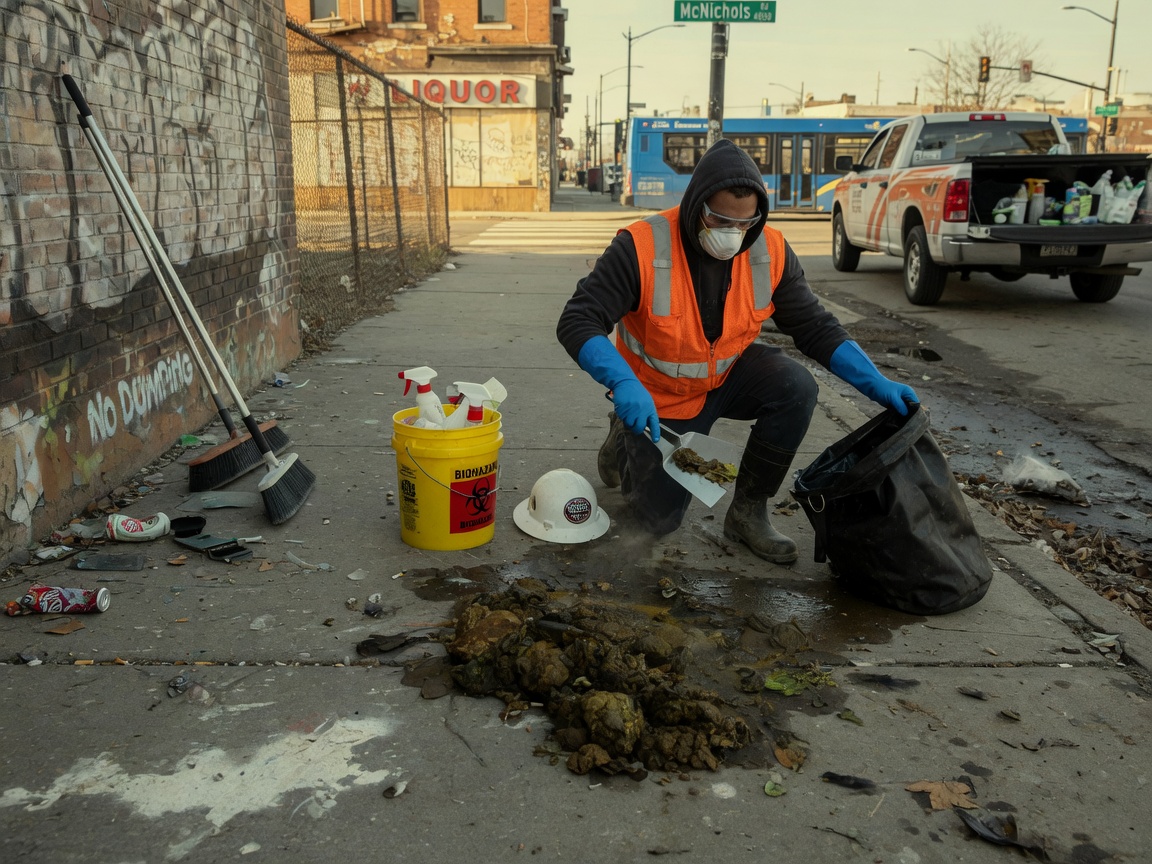
Detroit's older housing stock in neighborhoods such as Indian Village, Boston-Edison, and Woodbridge often features unfinished basements and crawl spaces where pet waste accumulates over years. Cold winters cause urine and feces to freeze against concrete and wood, then expand and seep into floor joists during spring thaws, creating hidden odor and bacterial growth that standard cleaning misses. Wayne County health rules require proper biohazard disposal for anything involving bodily fluids, and crews must account for limited alley access in dense blocks like Corktown when removing saturated materials.
Eastern Market and Mexicantown properties frequently involve commercial or mixed-use buildings where stray animal waste mixes with food-related debris, raising cross-contamination risks during warm summer months. Technicians use HEPA filtration and EPA-registered disinfectants rated for bloodborne pathogens because feces can carry bacteria that survive on porous surfaces common in pre-1940 construction. Snow accumulation on narrow driveways in Palmer Park or Midtown can delay equipment staging, so jobs planned during December through February require extra time for site preparation.
Near Belle Isle Park and Campus Martius Park, properties sometimes see waste from wildlife or dumped animals that homeowners discover only after spring flooding. Soil in these areas holds moisture longer, so subfloor drying may require industrial air movers for several days. Crews document every step for insurance or landlord reporting because Wayne County properties in rental-heavy zones like Hamtramck often trigger additional notification requirements when waste volume exceeds small residential amounts.
Technician insight
In Detroit, the thing that catches most people out with Animal Waste & Feces Cleanup is how our cold winters let urine soak into old plaster and joists in Boston-Edison or Woodbridge basements, then thaw and spread bacteria once the furnace kicks on in spring.
Corktown Basement Discovery
Homeowner in Corktown found extensive pet waste under a porch addition after a pipe leak. Crew removed frozen feces and saturated subfloor during a January thaw, treated for bacteria, and dried the space over three days. Property passed inspection and was returned to use without odor return.
Animal Waste & Feces Cleanup Services We Offer
✓Basement Pet Waste Removal
Extraction of accumulated urine and feces from Detroit basements, followed by subfloor drying and disinfection to stop odor migration into living spaces.
✓Hoarding Property Sanitation
Full removal and biohazard cleaning of feces and waste in hoarded homes across Wayne County, including sorting and disposal of contaminated items.
✓Attic Animal Waste Extraction
Removal of raccoon, squirrel, or cat waste from attics in older Detroit homes, with insulation replacement and vent sealing to prevent re-entry.
✓Vehicle Interior Decontamination
Deep cleaning of animal waste from cars, trucks, and vans used in Detroit daily commutes or left in driveways during winter weather.
✓Commercial Floor Waste Cleanup
Sanitation of feces and urine on concrete or tile floors in Eastern Market businesses and mixed-use buildings near Hamtramck.
Animal Waste & Feces Cleanup Cost in Detroit, MI
| Service | Typical Range | What Affects It |
|---|---|---|
| Small residential pet waste job | $250–$550 | Single room or small basement area in standard Detroit homes |
| Medium hoarding or multi-room cleanup | $600–$1,400 | Larger volume with multiple affected surfaces |
| Attic or crawl space extraction | $400–$900 | Includes insulation removal and access challenges in pre-war homes |
| Vehicle decontamination | $150–$350 | Interior only, varies with waste saturation and vehicle size |
Ranges are typical for Detroit, MI and confirmed with an exact written quote before any work starts.
How it works
- 1
Site Assessment
Technician inspects the affected area, notes access points in tight Detroit alleys, and identifies any frozen or water-damaged materials.
- 2
Containment Setup
Negative air machines and plastic barriers isolate the space to keep odors and particles from spreading through older home HVAC systems.
- 3
Removal and Disposal
Waste is bagged, saturated materials are cut out, and all items are transported for proper Wayne County biohazard disposal.
- 4
Disinfection and Drying
EPA-grade cleaners are applied, followed by dehumidification and air scrubbing until surfaces pass odor and swab testing.
Pricing
Cost depends on volume, access difficulty in older homes, and whether winter conditions affect the job.