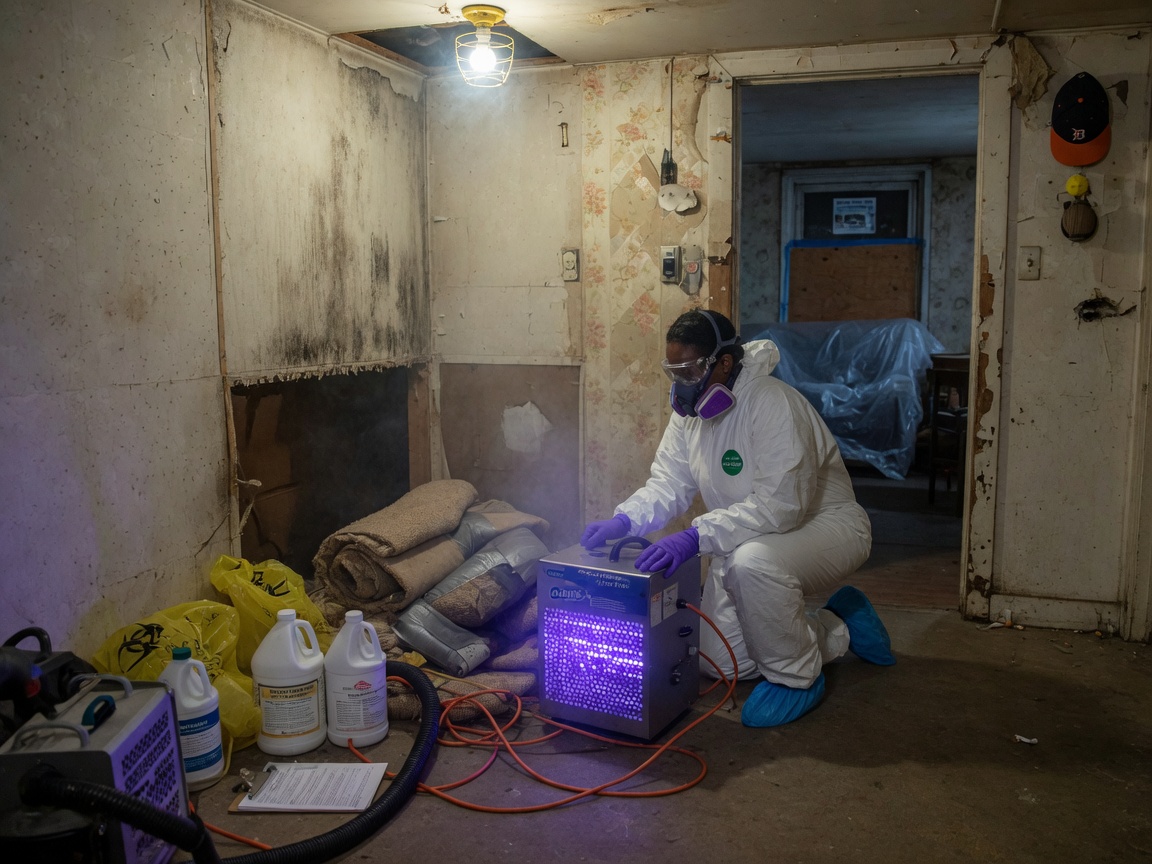
Detroit's older housing stock in neighborhoods like Boston-Edison and Woodbridge often features plaster walls, hardwood floors over crawl spaces, and limited HVAC access that trap decomposition odors after a homicide. Cold winters drive homeowners to seal homes tightly, pushing volatile organic compounds deeper into insulation and subfloors while summer humidity accelerates bacterial growth in remaining fluids. Technicians must disassemble baseboards and test soil under concrete slabs common in Eastern Market row houses, because odor molecules bind to porous materials that standard cleaning cannot reach.
Foxtown-based crews respond to calls from nearby Hamtramck and Dearborn where multi-unit buildings share ventilation shafts, allowing odors to migrate between units after a trauma event. Snow accumulation in winter delays exterior ventilation and requires heated negative-air machines to prevent moisture from freezing inside containment barriers. In Palmer Park and Mexicantown properties with finished basements, crews frequently encounter odors absorbed into carpet padding and drywall that must be removed entirely rather than treated in place.
Seasonal shifts affect job duration: spring thaws can re-release odors from previously frozen ground around Belle Isle Park area homes, while fall humidity in Corktown demands longer dwell times for enzymatic neutralizers. Every project includes air sampling before clearance to confirm levels meet Wayne County health expectations without relying on fragrance masking.
Technician insight
In Detroit the thing that catches most people out with Severe Odor Removal is how quickly cold winter air locks odors into plaster and horsehair insulation in 1920s Corktown and Indian Village homes; once the furnace kicks on in spring the smell travels through every duct and people think the job is finished when it has only just started.
Corktown Row House After Extended Recovery
Odors had migrated from a second-floor bedroom into the shared stairwell and basement joists of a 1910 brick home. Crews removed saturated plaster and subfloor sections, treated the dirt crawl space, and ran continuous air scrubbing for 72 hours. Air sampling cleared the property before the family returned.
Severe Odor Removal Services We Offer
✓Decomposition Odor Neutralization
Enzymatic treatment and air scrubbing to break down proteins left after extended body recovery in single-family homes and apartments.
✓Blood and Fluid Odor Extraction
Removal of dried blood and bodily fluids from subfloors and concrete in older Detroit properties where odors have penetrated porous surfaces.
✓Hvac System Odor Decontamination
Duct cleaning and coil treatment to stop odor migration through shared systems common in Midtown and Indian Village multi-unit buildings.
✓Crawl Space and Basement Odor Control
Sealing and treatment of dirt floors and joists in Woodbridge and Boston-Edison homes where moisture and cold temperatures trap odors.
✓Vehicle and Garage Odor Removal
Interior and trunk cleaning for personal vehicles used during incidents in Dearborn and Hamtramck neighborhoods.
Severe Odor Removal Cost in Detroit, MI
| Service | Typical Range | What Affects It |
|---|---|---|
| Single-room odor treatment | $650–$1,200 | Higher when subfloor removal is needed in older homes |
| Whole-house odor removal | $1,800–$3,500 | Increases with shared ventilation in multi-unit buildings |
| Basement or crawl-space treatment | $900–$1,600 | Depends on access and soil exposure |
| Vehicle interior decontamination | $350–$650 | Varies by vehicle size and trunk involvement |
Ranges are typical for Detroit, MI and confirmed with an exact written quote before any work starts.
How it works
- 1
Scene Assessment
Technicians inspect all affected rooms, HVAC returns, and exterior soil around the property to map odor migration paths.
- 2
Source Removal
Porous materials such as carpet, drywall, and insulation that hold odor are cut out and bagged for proper disposal.
- 3
Neutralization Application
Enzyme solutions and oxidizers are applied to remaining surfaces and allowed appropriate dwell time based on temperature.
- 4
Air Scrubbing And Verification
HEPA and activated-carbon units run until air sampling confirms odor compounds have dropped below detection thresholds.
Pricing
Cost depends on square footage treated, number of rooms, and whether HVAC or soil remediation is required.